

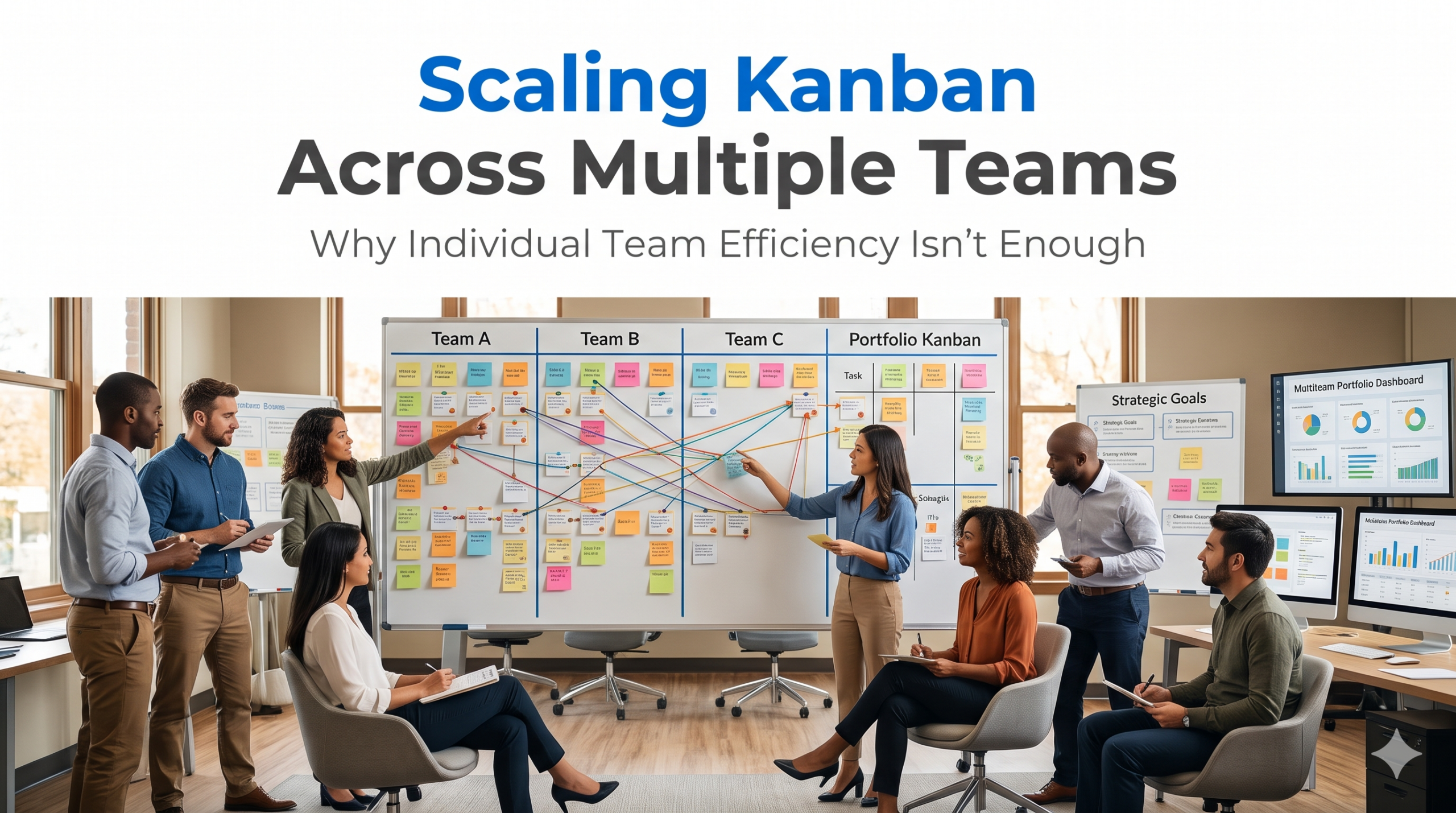
Aligning Multiple Teams: Scaling Kanban for Strategy-Driven Delivery
Every team has a Kanban board. Tasks move through different stages, meetings happen regularly, and individual teams appear to be making progress.
Yet important projects still miss deadlines.
Development waits for design. Testing waits for a shared environment. Security reviews pile up. Marketing commits to a launch date that engineering cannot support.
Each team may be working efficiently within its own boundaries, but the overall delivery process remains slow.
This is a common challenge for growing organizations. As more teams become involved in an initiative, dependencies increase, priorities compete, and work can get stuck between departments.
Scaling Kanban across multiple teams is about making the entire delivery process visible—not simply creating more Kanban boards.
In this guide, we’ll explore how organizations can connect team workflows, manage dependencies, control work in progress, measure delivery performance, and improve collaboration without introducing unnecessary bureaucracy.
What Does Scaling Kanban Across Multiple Teams Mean?
Kanban is a visual approach to managing work and improving flow. Teams use boards, explicit workflow policies, and work-in-progress limits to understand how work moves from start to finish.
When multiple teams contribute to the same initiative, however, an individual team’s board only tells part of the story.
For example, a customer onboarding improvement might involve product design, software development, cybersecurity, quality assurance, and customer support.
Each team has its own responsibilities, but the customer experiences one complete outcome.
Scaling Kanban means connecting these individual workflows so the organization can understand:
- How work moves across teams
- Where requests and deliverables become blocked
- Which dependencies are affecting progress
- How much work is active across the system
- Whether delivery commitments are realistic
- Whether completed work produces the intended customer value
The objective is not to force every team to use an identical workflow. It is to create visibility and coordination where their work intersects.
1. Start With the Customer Outcome
Before connecting Kanban boards, identify what the organization is trying to deliver.
Consider an initiative to introduce self-service account recovery. Product design, development, security, testing, and support documentation may all contribute to the outcome.
Start by tracing the work from the original request to the point where customers can actually use the capability.
Ask a few practical questions:
- Where does the request enter the system?
- When does the organization commit to delivering it?
- Which teams contribute?
- Where does work wait?
- Which approvals are required?
- What must happen before the customer can use the result?
Include activities such as security reviews, approvals, release preparation, and operational readiness. These stages are often overlooked when teams focus only on their own tasks.
It is also important to define completion clearly.
“Development complete” may mean the engineering team has finished its work. “Available to customers with support ready” represents a broader delivery outcome.
Both milestones are useful, but they should not be confused.
Practical tip: Choose one customer-facing deliverable and map its complete journey before attempting to scale the approach across the organization.
2. Connect Team Boards Through a Shared Delivery View
Individual teams need detailed boards to manage their daily work. Leaders and delivery coordinators need visibility into the larger initiative.
One practical approach is to maintain team-level Kanban boards alongside a shared view of initiatives or customer deliverables.
For example, a shared delivery item might be called “Launch self-service account recovery.”
Its supporting work could include:
- Interface design
- Identity verification
- Security assessment
- Development
- Acceptance testing
- Support documentation
- Production release
The shared item represents the outcome, while the linked cards represent the work needed from individual teams.
This distinction matters. Completing several development tasks does not automatically mean the customer deliverable is ready.
For each shared delivery item, make the following information visible:
- Expected outcome and acceptance criteria
- Contributing teams and linked work
- Dependencies and unresolved decisions
- Person coordinating the overall deliverable
- Current status and supporting evidence
- Expected delivery date, where applicable
Where possible, connect these views through your work management platform instead of relying on repeated manual updates.
Teams should retain workflows suited to their responsibilities. The most important agreements are those that govern handoffs, readiness, ownership, and completion.
3. Control Work in Progress Across the Entire System
One of the biggest challenges in multi-team delivery is the accumulation of too much active work.
Imagine five teams supporting twelve initiatives. Each team appears busy, but all twelve initiatives depend on the same small security team.
The security queue grows, reviews take longer, and downstream teams remain blocked.
The problem is not necessarily a lack of effort. It may be a mismatch between the amount of work entering the system and the capacity available to complete it.
To address this challenge:
Set work-in-progress limits. Establish practical limits for active work within individual workflows and, where useful, across shared delivery stages.
Limit active initiatives. Starting fewer initiatives can help teams finish important work instead of spreading capacity across too many commitments.
Monitor aging work. Identify items that have remained unfinished or blocked longer than expected.
Manage shared constraints. When a specialist team becomes overloaded, consider reducing incoming demand, helping resolve the bottleneck, or revisiting existing commitments.
Make urgent work explicit. Define who can authorize an exception and what impact that exception has on other priorities.
Treat initial limits as experiments. Review actual flow data and adjust the limits as the system’s behavior becomes clearer.
The key principle is simple: every new priority consumes capacity that must come from somewhere.
4. Turn Dependencies Into Working Agreements
A dependency label such as “Waiting for Security” provides visibility, but it does not explain how the work will move forward.
Has the security team accepted the request? Is the required documentation complete? When is the review needed? Who will respond if the work cannot proceed?
For recurring dependencies, create clear working agreements covering:
- Required information
- Acceptance criteria
- Request ownership
- Expected response times
- Escalation routes
- Communication responsibilities
For example:
“Security review requests must include an architecture summary, relevant data flows, and available test evidence. Incomplete requests will be returned with the missing information identified.”
This agreement makes expectations clear for both teams.
For important dependencies, assign a coordinator who follows the issue through to resolution. Coordination should result in a decision, a committed next action, or a clear escalation—not just another status update.
If the same handoff repeatedly causes delays, investigate the underlying cause. Potential improvements include earlier specialist involvement, reusable guidance, automated checks, or broader skills within the delivery team.
Use dependency information to improve the system, not merely to report delays.
5. Measure Flow Across Teams
Kanban flow metrics help teams understand how work moves through a system.
Four useful measures are:
Work in Progress (WIP): The number of work items currently underway.
Throughput: The number of work items completed during a defined period.
Work Item Age: How long an unfinished item has been in progress.
Cycle Time: The elapsed time between an agreed start point and finish point.
These measures can help identify bottlenecks, understand delivery patterns, and improve forecasting.
However, multi-team measurement requires care.
A completed design task, a resolved incident, and a customer-facing feature are different units of work. Combining their counts into one throughput figure may produce a misleading picture of performance.
Track customer deliverables separately from their supporting tasks. Define consistent measurement boundaries and examine the context behind the numbers.
For forecasting, a service level expectation can describe the proportion of comparable work items expected to finish within a given period, based on historical cycle-time data.
For example, historical data might support an expectation that 85% of comparable items finish within 20 days. This is a probabilistic forecast, not a guaranteed deadline.
Avoid adding together team-level percentile forecasts and treating the result as an equivalent end-to-end delivery probability. The relationship between teams, dependencies, and queues makes the overall flow more complex.
Finally, connect delivery metrics to customer outcomes. Faster completion matters when the delivered change solves the intended problem.
6. Make Coordination Meetings Produce Decisions
Cross-team coordination meetings can quickly become a sequence of status reports.
To make these meetings useful, organize the discussion around work that requires joint action.
Review the shared delivery view and ask:
- Which deliverable faces the greatest delivery risk?
- Which dependency needs a decision?
- Where is work accumulating?
- What can the teams finish before starting something else?
- Which commitment needs to change?
- Who has the authority to resolve the blocker?
Invite the people who can resolve the issue or authorize the required decision.
For each significant problem, record an action, an owner, and a review date. If none of these is identified, the meeting may increase awareness without improving delivery.
Meeting frequency should reflect the situation. Teams with frequent, time-sensitive dependencies may need brief daily coordination. Others may work better with less frequent reviews supported by reliable asynchronous updates.
Leadership involvement becomes important when resolving an issue requires changes to funding, staffing, organizational priorities, or policy.
7. Scale Through Evidence and Continuous Improvement
Attempting to redesign every team’s workflow at once can create unnecessary disruption.
A more practical approach is to start with one meaningful delivery flow involving a small group of connected teams.
Choose an initiative where better coordination could improve customer outcomes and where participants have the ability to address the main constraints.
Establish a baseline, agree on how the work will be represented, and test a manageable set of changes.
Review whether:
- Waiting time has decreased
- Work-item age has improved
- Dependencies are resolved more quickly
- Commitments have become clearer
- Customer deliverables finish more predictably
- Quality and customer outcomes remain healthy
Make trade-offs visible. A change that improves one team’s performance while increasing delays elsewhere needs further investigation.
Expand the approach when the results justify doing so. Share the principles and lessons learned, while allowing each new group to adapt the details to its working environment.
Leadership behavior also matters. If managers reward starting more initiatives or keeping every specialist fully occupied, teams will struggle to protect shared delivery commitments.
Recognize people who resolve bottlenecks, challenge unrealistic commitments, and improve cross-team handoffs.
These behaviors turn collaboration from an aspiration into an operating practice.
Common Mistakes When Scaling Kanban
Avoid these common pitfalls:
Creating one enormous board: A board that attempts to represent every task across the organization can become difficult to maintain and interpret.
Standardizing every team’s workflow: Different teams may need different processes. Standardize important handoffs and shared policies instead of forcing identical workflows everywhere.
Ignoring shared bottlenecks: Team-level efficiency does not guarantee end-to-end delivery efficiency.
Measuring activity instead of outcomes: More completed tasks do not necessarily mean more customer value.
Starting too many initiatives: Excessive work in progress increases context switching and can create longer queues.
Holding meetings without decision ownership: Every important blocker needs a clear owner and a path to resolution.
A Practical Checklist for Scaling Kanban
Before expanding Kanban across multiple teams, ask:
- Can we trace a customer deliverable through all contributing teams?
- Are the shared workflow stages and completion criteria clear?
- Are dependencies visible and assigned to owners?
- Are work-in-progress limits appropriate?
- Can we identify the oldest blocked work?
- Are flow metrics measured consistently?
- Do coordination meetings produce decisions and actions?
- Are delivery commitments based on evidence?
- Are we measuring customer outcomes alongside delivery performance?
- Have we tested the approach before expanding it?
If several answers are unclear, use them to define the first improvement experiment.
Final Thoughts
Scaling Kanban across multiple teams is not primarily a board-design exercise. It is an effort to make the entire delivery system easier to understand and improve.
Individual teams need the freedom to manage their work effectively. At the same time, the organization needs visibility into dependencies, queues, priorities, constraints, and customer outcomes.
By connecting team workflows through shared delivery views, controlling work in progress, establishing clear dependency agreements, and using meaningful flow metrics, organizations can make better decisions about what to start, what to finish, and where to intervene.
The objective is not to keep every team busy. It is to help the organization deliver valuable outcomes more predictably.
A useful question to start with is this: Where does work wait the longest between your teams, and who has the authority to improve that part of the journey?