
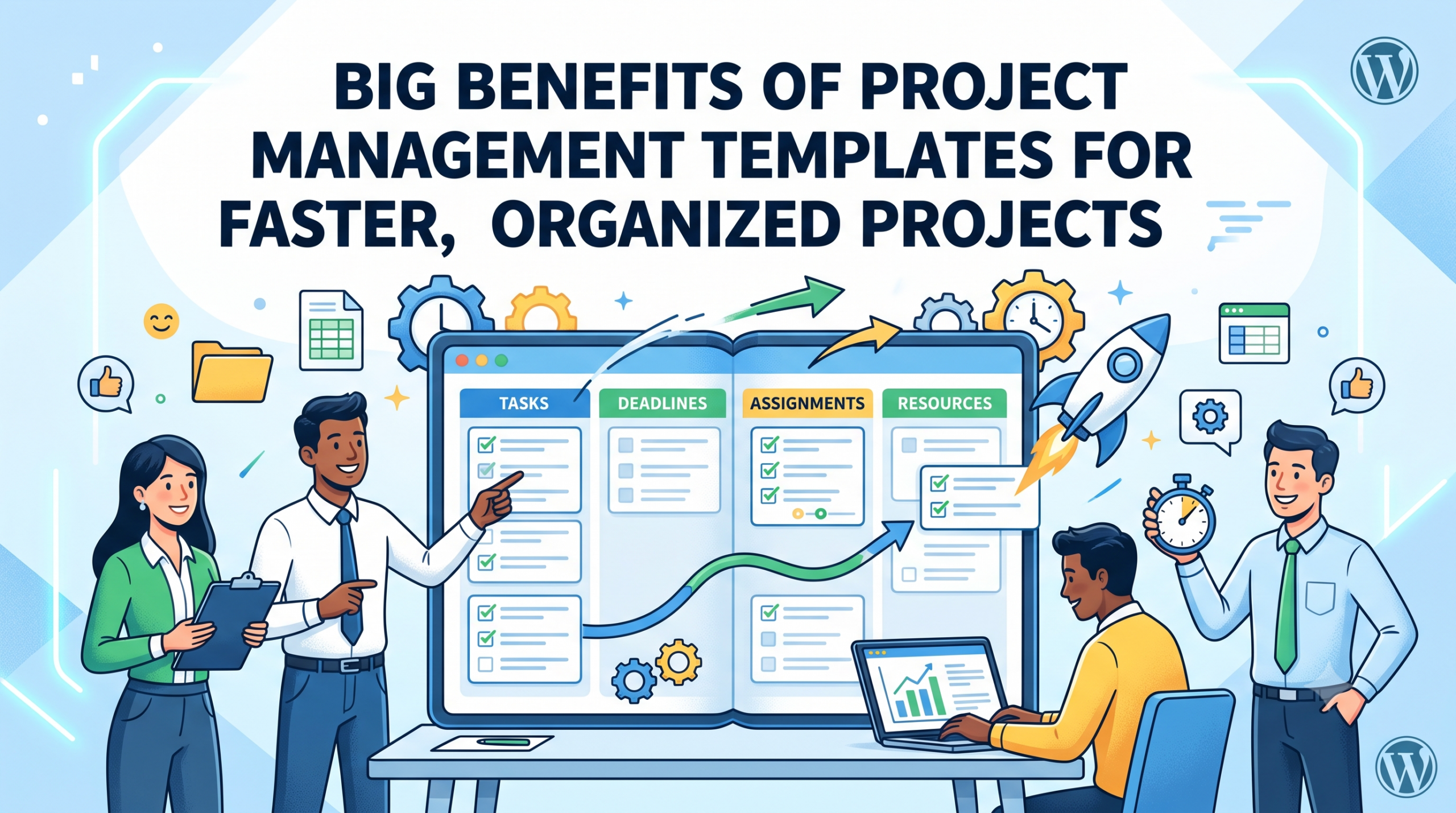
Big Benefits of Project Management Templates for Faster, More Organized Projects
Managing a project can quickly become complicated. There are tasks to track, deadlines to meet, budgets to control, risks to manage, stakeholders to update, and decisions to document. When project information is scattered across spreadsheets, emails, chat messages, and personal notes, even a capable team can lose valuable time.
This is where project management templates can make a significant difference.
A good project management template provides a ready-made structure for planning, tracking, reporting, budgeting, managing risks, and closing projects. Instead of starting every document from a blank page, project managers can work with a proven framework and focus more of their time on delivery and decision-making.
For project managers, PMO teams, business owners, consultants, contractors, team leaders, and freelancers, templates can turn repetitive administrative work into a more consistent and manageable process.
In this article, we explore 9 major benefits of project management templates and explain how they can improve project planning, communication, accountability, risk management, and overall project control.
What Are Project Management Templates?
A project management template is a pre-designed document, spreadsheet, dashboard, or framework used to manage a specific project activity.
Instead of creating a project plan, risk register, budget tracker, or status report from scratch, you can use a ready-to-customize format.
Common examples include:
- Project Charter Template
- Project Plan Template
- Project Schedule Template
- Gantt Chart Template
- Work Breakdown Structure (WBS) Template
- Risk Register Template
- Issue Log Template
- Project Budget Template
- Stakeholder Register Template
- RACI Matrix Template
- Project Status Report Template
- Change Request Template
- Meeting Minutes Template
- Project Closure Report
- Lessons Learned Template
A template is more than just a document. It provides a structured way to think about what information needs to be captured, reviewed, communicated, and monitored.
Why Are Project Management Templates Important?
Project management involves much more than assigning tasks.
A project manager needs to manage scope, schedule, cost, quality, resources, risks, issues, stakeholders, communication, changes, and approvals.
Without a consistent system, project information can quickly become fragmented.
For example, the task list might be in Excel, risks might be discussed in email, budget information might sit with the finance team, and important decisions might exist only in meeting notes.
This creates unnecessary friction.
Project management templates bring important information into a structured format. A project charter can establish the project’s purpose and objectives. A project plan can define how the work will be delivered. A risk register can highlight potential threats, while a status report can provide stakeholders with a quick view of project health.
The result is a more organized project management process.
Benefit 1: Project Management Templates Save Time
One of the biggest advantages of project management templates is time savings.
Starting every project document from scratch takes time. The project manager needs to decide what sections to include, how to structure the information, which fields are required, and how the document should be presented.
A ready-made template removes much of this repetitive work.
For example, a weekly project status report may require information about:
- Overall project status
- Completed activities
- Upcoming milestones
- Schedule
- Budget
- Risks
- Issues
- Dependencies
- Decisions required
- Next steps
Instead of recreating this structure every week, a project manager can update the existing template.
Templates reduce repetitive administrative work
Consider a PMO managing multiple projects. If every project manager creates reports differently, considerable time can be spent formatting and consolidating information.
A standardized template allows teams to focus on project information rather than document creation.
This gives project managers more time to:
- Review risks
- Resolve issues
- Communicate with stakeholders
- Support team members
- Analyze project performance
- Make decisions
- Improve delivery
The objective isn’t simply to work faster. It is to spend more time on work that actually moves the project forward.
Benefit 2: Templates Improve Project Consistency
Consistency is critical when multiple projects or teams are involved.
Imagine an organization where five project managers use five completely different status-report formats.
One report may include budget information. Another may focus only on tasks. A third may use different risk ratings.
Senior management then has to interpret every report differently.
A standardized project management template creates a common language.
Everyone can work with the same basic structure, terminology, and reporting approach.
Consistency helps PMO teams
For organizations managing multiple projects, standardized templates can make portfolio-level reporting significantly easier.
For example, every project could report:
- Project health
- Schedule status
- Budget status
- Scope status
- Top risks
- Open issues
- Key milestones
- Decisions required
This makes it easier for management to compare projects and identify areas requiring attention.
Templates also support onboarding
A new project coordinator or junior project manager can understand the organization’s preferred approach more quickly when templates are already available.
The template becomes a practical guide to how the team manages projects.
Benefit 3: Templates Help Reduce Errors
Projects can be affected by small mistakes.
A missed approval, forgotten dependency, incorrect date, undocumented change, or untracked risk can eventually create a larger problem.
A structured template acts as a built-in checklist.
For example, a risk register might include:
| Field | Purpose |
|---|---|
| Risk ID | Unique identification |
| Risk Description | What could happen |
| Probability | Likelihood |
| Impact | Potential consequence |
| Risk Score | Overall priority |
| Risk Owner | Accountability |
| Response Plan | Planned action |
| Due Date | Review/response deadline |
| Status | Current condition |
Because the structure already exists, the project manager is less likely to overlook important information.
Templates support better documentation
The same principle applies to change requests.
A change request template can capture:
- Reason for change
- Scope impact
- Schedule impact
- Cost impact
- Resource impact
- Quality impact
- Risk impact
- Approval status
This provides decision-makers with the information they need before approving a change.
Templates don’t eliminate human error, but they can create a more systematic process for capturing and reviewing information.
Benefit 4: Templates Improve Project Planning
Good project execution starts with good planning.
A project plan template encourages the project manager to think beyond a simple task list.
Depending on the project, the template can cover:
- Project objectives
- Scope
- Deliverables
- Milestones
- Dependencies
- Resources
- Budget
- Risks
- Stakeholders
- Communication
- Assumptions
- Constraints
- Approvals
This creates a more complete view of the project before execution begins.
Templates help teams think systematically
A blank page can make planning difficult because the team has to decide where to begin.
A structured template provides a logical starting point.
For junior project managers, this can be particularly useful because it highlights areas they may otherwise overlook.
For experienced project managers, it reduces the need to recreate the same planning structure for every project
Benefit 5: Templates Make Project Communication Easier
Project management is heavily dependent on communication.
Project managers communicate with executives, clients, developers, designers, finance teams, vendors, contractors, and other stakeholders.
The challenge isn’t simply communicating more.
It is communicating the right information in a clear and structured way.
A project status report template can provide a consistent format for communicating:
- Current project status
- Completed work
- Upcoming activities
- Milestones
- Budget
- Risks
- Issues
- Delays
- Decisions required
- Support needed
Instead of writing a lengthy update every week, the project manager can present the key information in a predictable structure.
Structured communication saves stakeholder time
Executives and project sponsors often don’t need every project detail.
They usually want to know:
Are we on schedule?
Are we within budget?
What are the biggest risks?
What decisions are required?
What happens next?
A well-designed template makes these answers easier to find.
Benefit 6: Templates Improve Budget Control
Budget management is another area where templates can add significant value.
A project budget template can track:
- Planned cost
- Actual cost
- Committed cost
- Remaining budget
- Variance
- Forecast
- Vendor expenses
- Resource costs
- Contingency
For example, suppose a project has a planned budget of $100,000 but the current forecast is $112,000.
The project manager can identify a potential $12,000 budget variance early enough to investigate the cause and take corrective action.
Templates provide better financial visibility
A structured budget tracker makes it easier to identify:
- Unexpected expenses
- Cost overruns
- Unapproved spending
- Vendor costs
- Resource cost changes
- Forecast deviations
This allows project managers and finance teams to make decisions based on current information rather than waiting until project closure.
Benefit 7: Templates Improve Risk and Issue Management
Risks and issues are part of virtually every project.
The key is not to pretend that problems won’t happen.
The goal is to identify, prioritize, assign, and manage them effectively.
A risk register template provides a structured way to capture potential threats.
Typical fields include:
- Risk description
- Cause
- Probability
- Impact
- Risk score
- Mitigation action
- Risk owner
- Target date
- Current status
For example:
Probability = 4/5
Impact = 5/5
Risk score = 20
A high score indicates that the risk may deserve immediate attention.
Issue logs create accountability
An issue log focuses on problems that have already occurred.
It can include:
- Issue description
- Date raised
- Priority
- Owner
- Action required
- Target resolution date
- Status
- Resolution notes
This prevents important problems from getting lost in meetings, emails, or chat conversations.
Benefit 8: Templates Support Better Decision-Making
Project managers make decisions throughout the project lifecycle.
Should additional resources be added?
Should a milestone be moved?
Should a change request be approved?
Should a risk be escalated?
Should the project budget be adjusted?
Good decisions require good information.
A project dashboard or project reporting template can bring important information together.
For example, a dashboard might show:
- Project completion percentage
- Schedule variance
- Budget variance
- Open risks
- Open issues
- Milestone status
- Resource utilization
The combination of these metrics provides a more complete picture of project health.
Templates turn scattered data into actionable information
A single report provides a snapshot.
A consistent template used every week or month can also reveal trends.
For example:
- Are risks increasing?
- Is progress slowing?
- Are costs rising?
- Are more tasks becoming overdue?
- Are approvals taking longer?
These trends can help project managers identify problems earlier.
Benefit 9: Templates Increase Professionalism and Trust
The final benefit is often underestimated: professionalism.
A clean project charter, well-organized project plan, structured dashboard, and consistent status report can create confidence among stakeholders.
Clients and executives don’t necessarily expect a project to have zero problems.
They want confidence that problems are visible, owned, and being managed.
Compare these two statements:
“We are working on the issue.”
with:
“Issue #14 is assigned to the technical lead, the mitigation action is underway, and the target resolution date is Friday.”
The second statement provides much greater visibility.
Professional templates strengthen client relationships
A consistent reporting format can help clients understand:
- What has been completed
- What is currently in progress
- What is delayed
- What decisions are required
- What risks exist
- What happens next
This creates a more transparent project experience.
For consulting firms, agencies, contractors, IT service providers, and other project-driven organizations, that transparency can become a competitive advantage.
How Project Management Templates Help Different Roles
Project management templates aren’t only useful for project managers.
They can support the entire project ecosystem.
Project Managers
Use templates to plan, track, control, and report project performance.
PMO Teams
Use standardized templates to compare projects and create portfolio-level visibility.
Executives and Sponsors
Use dashboards and status reports to quickly understand project health.
Team Members
Use task trackers and responsibility matrices to understand ownership and deadlines.
Finance Teams
Use budget and cost templates to monitor spending.
Procurement Teams
Use vendor and purchase tracking templates.
Clients
Use status reports and dashboards to understand progress and pending decisions.
Consultants and Small Businesses
Use professional templates to create repeatable delivery processes.
Project Management Templates Across Different Knowledge Areas
Templates can support almost every major area of project management.
| Project Area | Useful Template |
|---|---|
| Scope | Scope Statement |
| Planning | Project Plan |
| Schedule | Gantt Chart |
| Tasks | Task Tracker |
| Cost | Budget Tracker |
| Risk | Risk Register |
| Issues | Issue Log |
| Resources | Resource Plan |
| Stakeholders | Stakeholder Register |
| Communication | Communication Plan |
| Responsibility | RACI Matrix |
| Changes | Change Request |
| Meetings | Meeting Minutes |
| Reporting | Status Report |
| Closure | Project Closure Report |
| Improvement | Lessons Learned |
The biggest advantage is that these templates can work together as a broader project control system.
Why Starting With a Blank Page Slows Projects Down
A blank document may look simple, but it creates many small decisions.
You need to decide:
- What sections should be included?
- What information should be captured?
- Which fields are mandatory?
- How should the information be presented?
- What formulas are required?
- How should risks be scored?
- How should project status be reported?
Those decisions consume time.
A template provides the initial structure so the project manager can focus on the actual project.
Think of it this way:
A template builds the road. The project team still drives the vehicle.
Project Management Templates Improve Accountability
Accountability becomes easier when ownership is visible.
A task tracker can identify:
- Task
- Owner
- Due date
- Priority
- Status
- Dependencies
A risk register identifies risk owners.
An issue log identifies people responsible for resolution.
A RACI matrix identifies who is:
- Responsible
- Accountable
- Consulted
- Informed
This reduces ambiguity and makes project conversations more fact-based.
Instead of asking:
“Who was supposed to do this?”
The team can simply check the project tracker.
Templates Are Especially Valuable for Remote and Hybrid Teams
Remote and hybrid teams have increased the importance of structured project information.
When team members work across different locations and time zones, informal conversations are less reliable.
Shared templates provide a common source of project information.
Useful templates for distributed teams include:
- Task trackers
- Meeting minutes
- Decision logs
- Project dashboards
- Risk registers
- Issue logs
- Status reports
A well-maintained template allows team members to understand project status without requiring another meeting.
Templates Improve the Client Experience
Clients want visibility and confidence.
A structured client status report can show:
- Project progress
- Completed deliverables
- Upcoming activities
- Pending approvals
- Risks
- Issues
- Decisions required
This helps clients understand not only what the project team is doing, but also where the client needs to take action.
Change request templates are particularly valuable because they document the impact of requested changes on:
- Scope
- Cost
- Schedule
- Resources
- Quality
- Risk
This reduces misunderstandings and creates a clearer approval process.
How Templates Help Small Businesses
Small businesses often don’t have dedicated PMO departments.
A founder or department manager may be responsible for sales, operations, project delivery, finance, and customer communication at the same time.
Templates provide a lightweight management system without requiring a large organizational structure.
A small agency, consultancy, contractor, or service business can start with just a few core templates:
- Project Plan
- Task Tracker
- Budget Tracker
- Risk Register
- Client Status Report
- Meeting Minutes
- Project Closure Report
These can create a repeatable operating model as the business grows.
Templates Also Improve Project Closure
Project closure is often overlooked.
Once the major deliverables are completed, teams may immediately move to the next project.
But a proper closure process should capture:
- Final deliverables
- Client acceptance
- Final cost
- Final schedule
- Outstanding items
- Handover information
- Lessons learned
- Final approvals
A project closure template creates a structured process for capturing this information.
Lessons learned are particularly valuable because they allow organizations to improve future projects.
If the same organization completes multiple projects, lessons from previous projects can become valuable institutional knowledge.
The Real Value of Project Management Templates
The real value of templates isn’t simply that they make documents faster to create.
Their bigger value is control.
Templates help teams answer important questions:
- What are we supposed to deliver?
- Who owns each task?
- Are we on schedule?
- Are we within budget?
- What risks are emerging?
- Which issues need attention?
- What decisions are pending?
- What should happen next?
Without structure, project management can become dependent on individual memory and communication.
With a standardized template system, project information becomes more visible, repeatable, and easier to manage.
Final Thoughts
Project management templates are more than downloadable files.
They are practical tools for creating structure, consistency, visibility, and accountability throughout the project lifecycle.
The nine major benefits are:
- Save time
- Improve consistency
- Reduce errors
- Improve planning
- Make communication easier
- Improve budget control
- Strengthen risk and issue management
- Support better decision-making
- Increase professionalism and trust
Whether you’re managing an IT implementation, construction project, marketing campaign, business transformation initiative, or client engagement, the right templates can help your team spend less time rebuilding documents and more time managing the work that matters.
The best project managers don’t try to remember everything.
They build systems.
They create repeatable processes, track important information, communicate consistently, identify risks early, and use data to make better decisions.
That is where project management templates become powerful.