

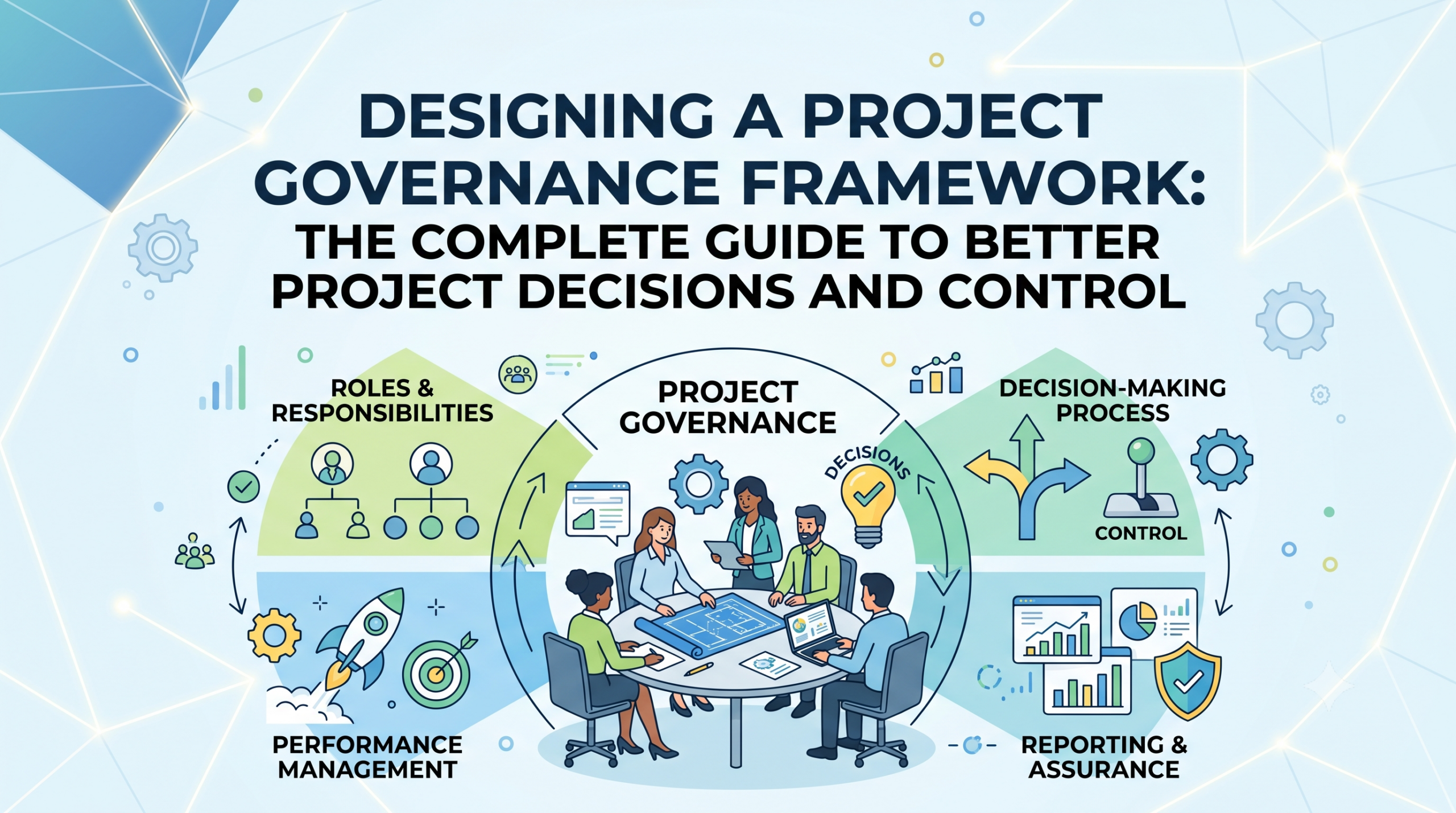
Designing a Project Governance Framework: The Complete Guide to Better Project Decisions and Control
Projects rarely fail simply because teams cannot create schedules, manage budgets, or execute technical work.
A more fundamental problem can emerge when nobody clearly knows who has decision-making authority, how important decisions should be made, when risks need to be escalated, who can approve changes, or who is accountable for project outcomes.
This is where a strong project governance framework becomes essential.
Organizations often invest heavily in project management methodologies, software, reporting systems, and professional training. However, these tools cannot compensate for unclear decision rights and weak accountability.
A well-designed project governance framework creates the structure needed to connect organizational strategy with project execution. It establishes clear roles, decision-making mechanisms, escalation paths, controls, reporting requirements, and review processes.
Most importantly, effective governance is not about creating unnecessary bureaucracy.
Good governance enables better decisions.
In this guide, we’ll explore what project governance means, why it matters, the key components of a governance framework, the roles involved, how to design a framework step by step, common mistakes to avoid, governance maturity levels, and how technology is shaping the future of project governance.
What Is Project Governance?
Project governance is the framework of policies, processes, roles, responsibilities, authority levels, controls, and decision-making mechanisms used to direct and oversee a project.
In practical terms, governance answers some of the most important questions a project team can face:
- Who makes important decisions?
- Who has approval authority?
- How are decisions documented?
- Who monitors project performance?
- When should a risk be escalated?
- Who can approve scope changes?
- Who owns project outcomes?
- How are benefits measured?
- What happens when a project moves outside agreed tolerances?
A project governance framework acts as the bridge between strategic objectives and project execution.
It helps ensure that project activities remain aligned with organizational priorities while maintaining appropriate control over scope, cost, schedule, quality, resources, risks, and expected benefits.
Why Every Project Needs a Governance Framework
Project governance provides structure without requiring management to control every operational detail.
When designed properly, governance can improve several critical areas of project delivery.
1. Strategic Alignment
Projects should exist for a reason.
Governance helps ensure that project objectives remain connected to organizational strategy and expected business outcomes.
If strategic priorities change, governance provides a mechanism for reviewing whether the project should continue, change direction, or be stopped.
2. Faster Decision-Making
Projects generate decisions continuously.
When authority is unclear, relatively simple decisions can become delayed because everyone is waiting for someone else to approve them.
A governance framework defines decision rights and approval thresholds.
This makes it easier to determine who should decide what and when escalation is necessary.
3. Improved Accountability
Strong governance makes ownership visible.
Stakeholders should understand:
- What they are responsible for
- What decisions they can make
- What they need to approve
- What they need to review
- What they need to escalate
This reduces ambiguity and creates clearer accountability throughout the project lifecycle.
4. Better Risk Management
Risks should not exist only inside a project risk register.
Effective governance establishes who owns risks, how frequently they are reviewed, when they should be escalated, and who has authority to approve responses.
This creates a more proactive approach to project risk management.
5. Greater Transparency
Leadership needs visibility into project performance.
A governance framework establishes appropriate reporting and review mechanisms covering areas such as:
- Schedule
- Budget
- Quality
- Risks
- Issues
- Resources
- Benefits
- Stakeholder concerns
The objective isn’t to produce more reports.
It is to provide the right information for better decisions.
6. Greater Stakeholder Confidence
Projects operate in environments where stakeholders need confidence that decisions are being made appropriately.
Sponsors, executives, customers, project teams, and business leaders are more likely to trust a project when roles, responsibilities, reporting, escalation, and decision-making processes are clear.
Core Components of a Project Governance Framework
An effective project governance framework consists of several connected components.
The exact structure will vary according to the organization, project size, complexity, risk profile, and regulatory environment.
However, most mature frameworks address the following areas.
1. Governance Structure
The governance structure defines the groups and roles responsible for project oversight and decision-making.
A typical structure may include:
- Executive Leadership
- Project Sponsor
- Steering Committee
- Project Management Office (PMO)
- Program Manager
- Project Manager
- Workstream Leads
- Project Team Members
Each level should have clearly defined responsibilities and authority.
The objective is not to create more management layers.
The objective is to ensure that decisions are made at the appropriate level.
2. Roles and Responsibilities
Unclear ownership is one of the biggest sources of project confusion.
A governance framework should explicitly define:
- Who approves budgets
- Who approves changes
- Who manages risks
- Who accepts deliverables
- Who resolves conflicts
- Who owns business benefits
- Who escalates major issues
- Who provides executive oversight
A RACI matrix can be particularly useful for clarifying who is Responsible, Accountable, Consulted, and Informed.
The important principle is simple:
Every critical decision and deliverable should have clear ownership.
3. Decision-Making Framework
Projects generate hundreds of decisions.
Without defined decision rights, teams can experience decision delays, unnecessary escalation, or conflicting approvals.
A governance framework should define:
- Decision categories
- Approval thresholds
- Authority levels
- Escalation paths
- Voting requirements, where applicable
- Documentation requirements
For example, a project manager might have authority to approve operational decisions within an agreed tolerance, while major budget or scope changes may require sponsor or steering committee approval.
The specific thresholds should be adapted to the organization’s operating model.
4. Risk Governance
Risk management should be integrated into project governance rather than treated as an isolated activity.
The governance framework should establish:
- Risk ownership
- Risk review frequency
- Escalation thresholds
- Response approval requirements
- Executive reporting
- Risk monitoring responsibilities
This ensures that significant risks receive the appropriate level of attention.
A project manager should not have to determine from scratch when a major risk needs executive attention. The governance framework should provide that pathway.
5. Change Governance
Change is inevitable in most projects.
The problem occurs when changes are accepted without understanding their impact.
A change governance process should define:
- How change requests are submitted
- What impact assessment is required
- Who can approve changes
- When a Change Control Board is required
- How approved changes are communicated
- How decisions are documented
The goal is not to prevent change.
The goal is to balance flexibility with control.
6. Performance Monitoring
Governance requires visibility.
Project performance can be monitored through appropriate measures such as:
- Schedule metrics
- Budget metrics
- Quality indicators
- Risk indicators
- Resource utilization
- Benefits realization
- Stakeholder satisfaction
The exact metrics should depend on the project’s objectives and governance requirements.
A useful governance report should answer:
What is happening?
Why does it matter?
What decision or action is required?
This is more valuable than producing large volumes of information that nobody uses.
Key Project Governance Roles Explained
A governance framework becomes effective when everyone understands their role.
Project Sponsor
The project sponsor provides executive ownership and helps maintain alignment between the project and organizational strategy.
Typical responsibilities include:
- Approving major decisions
- Securing funding
- Resolving escalated issues
- Supporting project success
- Maintaining strategic alignment
The sponsor often becomes the critical escalation point when project decisions exceed the authority of the project manager.
Steering Committee
The steering committee provides strategic oversight.
Its responsibilities may include:
- Reviewing project performance
- Approving significant changes
- Reviewing strategic risks
- Resolving cross-functional conflicts
- Supporting executive decisions
A steering committee should focus on governance and strategic oversight, not day-to-day project management.
That distinction is important.
If a steering committee begins managing individual tasks, the governance model can quickly become inefficient.
Project Manager
The project manager operates within the governance framework and remains responsible for project delivery.
Typical responsibilities include:
- Managing execution
- Coordinating stakeholders
- Monitoring performance
- Reporting project status
- Escalating risks and issues
- Implementing approved decisions
Effective governance should give the project manager enough authority to manage the project without forcing routine decisions through unnecessary approval layers.
Project Management Office (PMO)
The Project Management Office (PMO) can help standardize governance across projects.
Depending on the organization, a PMO may provide:
- Project methodologies
- Templates
- Reporting standards
- Governance reviews
- Portfolio oversight
- Performance analysis
- Project management guidance
A mature PMO can create consistency across projects while helping leadership gain portfolio-level visibility.
However, governance should remain proportionate to the organization’s size and project complexity.
How to Design a Project Governance Framework: 7 Steps
Designing governance doesn’t need to begin with a massive policy document.
A practical framework can be built progressively.
Step 1: Understand Organizational Strategy
Governance should support business strategy.
Before designing the framework, understand:
- Business goals
- Strategic priorities
- Risk tolerance
- Regulatory requirements
- Leadership expectations
A governance model that is disconnected from business strategy is unlikely to create meaningful value.
The first question should always be:
What outcomes does the organization need this project to achieve?
Step 2: Define Governance Principles
Establish the principles that will guide governance decisions.
Examples include:
- Transparency
- Accountability
- Consistency
- Compliance
- Stakeholder engagement
- Continuous improvement
These principles become the foundation for the rest of the governance framework.
For example, if transparency is a core principle, project reporting should provide stakeholders with sufficient information to understand performance and emerging concerns.
Step 3: Establish Governance Bodies
Determine which governance groups are actually necessary.
Depending on project complexity, these could include:
- Executive Board
- Steering Committee
- PMO Governance Council
- Change Control Board
- Risk Review Board
- Benefits Realization Committee
Not every project requires every governance body.
The principle should be:
Create governance where it adds decision-making value.
Every governance body should have a clearly defined purpose, membership, authority, meeting cadence, and decision scope.
Step 4: Define Roles and Decision Rights
Document who:
- Decides
- Approves
- Reviews
- Advises
- Informs
- Escalates
This removes ambiguity.
A useful governance document should make decision rights easy to understand rather than forcing people to interpret complicated organizational policies.
A RACI matrix can complement this structure by making responsibility and accountability visible across important project activities.
Step 5: Design Escalation Paths
Projects inevitably encounter problems.
The governance framework should define what happens when issues exceed agreed thresholds.
Define:
- Issue severity levels
- Escalation timelines
- Approval authorities
- Communication channels
- Resolution expectations
For example, an operational issue may remain with the project manager, while a significant budget, scope, regulatory, or strategic issue may require sponsor or steering committee involvement.
A clear escalation path helps prevent important issues from becoming trapped at the wrong management level.
Step 6: Define Reporting Requirements
Governance depends on reliable information.
Establish expectations for:
- Reporting frequency
- Dashboard standards
- KPIs
- Risk reporting
- Executive summaries
- Benefits tracking
The key principle is decision-oriented reporting.
Senior leaders rarely need every project detail.
They need the information required to understand performance, identify exceptions, and make decisions.
Step 7: Implement Review Mechanisms
Governance should operate throughout the project lifecycle.
Useful review mechanisms can include:
- Stage gates
- Phase reviews
- Steering committee meetings
- Risk reviews
- Change reviews
- Portfolio reviews
- Lessons learned sessions
These checkpoints provide opportunities to evaluate whether the project remains aligned with expectations.
They can also help leadership identify when corrective action is required.
Common Project Governance Mistakes
Even experienced organizations can design governance systems that create unnecessary friction.
Mistake 1: Too Much Bureaucracy
Governance should support decisions, not prevent them.
Too many approval layers, forms, meetings, and reports can slow delivery.
The answer isn’t to eliminate governance.
It is to right-size governance.
Mistake 2: Unclear Accountability
If nobody clearly owns a decision, project issues can remain unresolved.
Every important governance activity should have a defined owner and appropriate authority.
Mistake 3: Weak Executive Engagement
Executive sponsorship cannot be purely symbolic.
If sponsors and senior stakeholders disengage, important escalations may remain unresolved.
Strong governance requires active leadership participation at the appropriate level.
Mistake 4: Overcomplicated Reporting
More metrics don’t automatically create better governance.
Executives generally need meaningful decision-support information rather than hundreds of disconnected metrics.
Focus reporting on:
- Exceptions
- Trends
- Risks
- Decisions
- Outcomes
- Business impact
Mistake 5: Copying Another Organization’s Governance Model
A governance framework that works for a multinational organization may be excessive for a small business.
Likewise, a lightweight model may be inadequate for a highly regulated or strategically critical program.
Governance should reflect:
- Organizational culture
- Project complexity
- Risk profile
- Regulatory environment
- Decision-making style
- Stakeholder expectations
There is no universal governance framework.
Project Governance Maturity Levels
Organizations can also evaluate governance maturity progressively.
Level 1 — Ad Hoc
Typical characteristics:
- Minimal structure
- Inconsistent decision-making
- Reactive management
- Limited documentation
Governance largely depends on individuals.
Level 2 — Defined
At this stage:
- Basic governance processes exist
- Roles are documented
- Reporting becomes more standardized
- Decision processes become clearer
The organization is beginning to move from informal management toward repeatable governance.
Level 3 — Managed
Governance is consistently applied across projects.
Organizations begin using performance information to support decisions, while executive oversight becomes more structured.
Level 4 — Integrated
Governance becomes connected with:
- Portfolio management
- Program management
- Strategic planning
- Benefits realization
Project decisions are increasingly considered within the broader organizational context.
Level 5 — Optimized
At the highest maturity level, governance becomes continuously improved.
Organizations use:
- Performance data
- Lessons learned
- Predictive insights
- Automation
- Continuous improvement practices
The objective is to make decision-making more effective, consistent, and predictable.
The Future of Project Governance
Project governance is evolving alongside technology.
Artificial intelligence, predictive analytics, real-time dashboards, and automated reporting are changing how organizations monitor and govern projects.
Future governance models are likely to place increasing emphasis on:
- Predictive risk detection
- Automated compliance monitoring
- AI-supported decision-making
- Real-time portfolio visibility
- Data-driven governance insights
- Automated reporting
- Early-warning indicators
The opportunity isn’t to replace governance with technology.
It is to use technology to give governance bodies better information at the right time.
A future governance framework could identify emerging project risks before they become major issues, automatically surface exceptions, and provide leadership with real-time visibility across a portfolio.
Project Governance vs Project Management
These concepts are closely connected, but they are not the same.
Project governance establishes the framework for authority, accountability, oversight, decision-making, and control.
Project management focuses on planning and executing the work required to deliver the project.
A simple way to think about the distinction is:
Governance determines how the project is directed and controlled. Project management determines how the work gets delivered.
Both are necessary.
Strong project management without appropriate governance can result in good execution that is poorly aligned or inadequately controlled.
Strong governance without effective project management can produce excellent oversight but weak delivery.
The two disciplines need to work together.
How to Make Project Governance More Effective
A practical governance framework should be:
Clear
Everyone should understand who has authority and accountability.
Proportionate
Governance should match the size, complexity, risk, and importance of the project.
Transparent
Key decisions, risks, changes, and performance information should be visible to the appropriate stakeholders.
Decision-Oriented
Governance meetings and reports should help people make decisions rather than simply generate documentation.
Adaptable
Governance should evolve when project conditions, organizational priorities, or risks change.
Measurable
Organizations should be able to evaluate whether governance is actually improving project outcomes.
Final Thoughts
A project can have an excellent schedule, experienced professionals, a strong budget, and sophisticated technology and still struggle when decision-making and accountability are unclear.
That is why project governance matters.
A well-designed project governance framework creates clarity around authority, responsibilities, escalation, risk, change, reporting, and oversight.
It connects strategic objectives with project execution and gives stakeholders a structured way to make important decisions.
The most effective governance frameworks don’t create unnecessary bureaucracy.
They create clarity when complexity increases.
They provide structure when uncertainty appears.
They establish accountability when difficult decisions need to be made.
And they give leadership the visibility needed to keep projects aligned with business objectives.
The goal is not more meetings, more forms, or more approvals.
The goal is better decisions, stronger accountability, greater transparency, and better project outcomes.
Ultimately:
Project management helps deliver the work. Project governance helps ensure that the right work is being delivered, by the right people, with the right decisions and controls in place.
Organizations that treat governance as a strategic capability—not simply an administrative process—can build a more consistent and resilient approach to project delivery.
[…] When Should You Assemble a Project Team? […]
[…] steering committee provides senior-level governance, strategic direction, escalation support, and decision-making for projects that have significant […]