

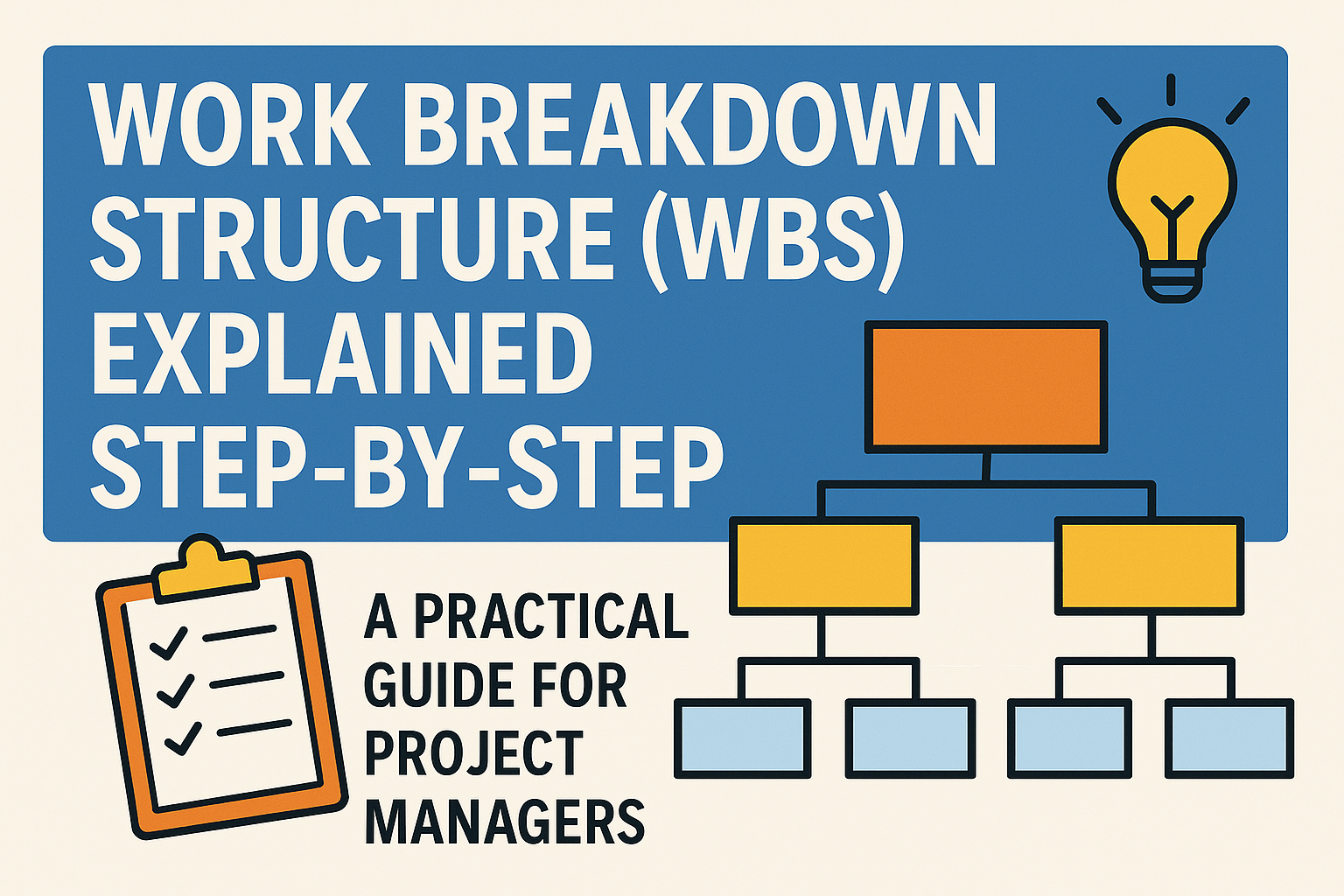
Work Breakdown Structure (WBS) Explained Step-by-Step: A Practical Guide for Project Managers
In project management, clarity determines success.
Projects rarely fail because teams lack effort. They fail because scope was never broken down properly. When work isn’t structured clearly, estimation becomes guesswork, accountability becomes blurred, and scope creep becomes inevitable.
That’s why the Work Breakdown Structure (WBS) is one of the most powerful tools in professional project management.
If you want predictable timelines, realistic budgets, and controlled delivery, mastering the WBS is essential. In this guide, you’ll learn what a WBS is, why it matters, and how to build one step by step.
What Is a Work Breakdown Structure (WBS)?
A Work Breakdown Structure (WBS) is a hierarchical breakdown of the total project scope into smaller, manageable components known as work packages.
In simple terms, a WBS answers one core question:
“What exactly must be delivered to complete this project?”
It focuses on deliverables — not activities.
That distinction changes everything.
Why the WBS Is So Important
Experienced project managers never skip this step because the WBS:
- Clarifies total scope
- Prevents scope creep
- Improves cost estimation accuracy
- Makes scheduling structured
- Defines accountability
- Reduces risk
- Aligns stakeholders around deliverables
Without a WBS, planning is reactive.
With a WBS, planning becomes measurable and controlled.
Core Principles of a Strong WBS
Before building one, understand these three essential rules:
1. The 100% Rule
The WBS must include 100% of the project scope — no more, no less.
If it’s not in the WBS, it’s not part of the project.
2. Deliverable-Oriented Structure
A WBS is organized around outcomes, not actions.
Wrong approach:
- Design homepage
- Write code
- Test system
Correct approach:
- Website design package
- Backend module
- Testing & validation package
Deliverables define what must exist when the project is complete.
3. Progressive Decomposition
Break large deliverables into smaller components until they are manageable and measurable.
This is where structure turns complexity into control.
Step-by-Step Guide to Creating a WBS
Step 1: Define the Project Objective Clearly
Before building a WBS, clarify:
- What problem are we solving?
- What is the final deliverable?
- What does success look like?
Vague objective:
“Build a website.”
Clear objective:
“Design and launch a 10-page corporate website with CMS, hosting setup, and SEO configuration.”
Precision drives structure.
Step 2: Identify Major Deliverables (Level 1 & Level 2)
Start with high-level deliverables.
Example: Website Project
Level 1: Corporate Website Launch
Level 2:
- Design
- Development
- Content
- Testing
- Deployment
- Training & Handover
These are deliverable categories — not tasks.
Step 3: Decompose Each Deliverable
Break each major component into smaller elements.
Example: Design
- Wireframes
- UI mockups
- Brand alignment
- Design approval package
Continue decomposing until you reach manageable units.
Step 4: Define Work Packages
A work package is the lowest level of the WBS.
It should be:
- Small enough to estimate
- Clear enough to assign
- Measurable
- Controlled in scope
A practical guideline: a work package should represent roughly 8–80 hours of effort (depending on project scale).
Instead of:
“Develop backend”
Break it into:
- Database schema creation
- Authentication module
- Admin dashboard logic
- API integration
Now estimation becomes realistic.
Step 5: Assign WBS Codes
Each element should follow a numbering structure.
Example:
1.0 Website Project
1.1 Design
1.1.1 Wireframes
1.1.2 UI Mockups
1.1.3 Design Approval
WBS coding:
- Improves tracking
- Supports reporting
- Links to cost codes
- Connects to scheduling tools
Professional PMOs rely heavily on structured WBS numbering.
Step 6: Validate the 100% Rule
Review your WBS and confirm:
- Have we included everything required?
- Is anything duplicated?
- Are any deliverables unclear?
- Are stakeholders aligned?
Reviewing with stakeholders prevents future disputes and change conflicts.
Step 7: Create the WBS Dictionary
The WBS diagram alone is not enough.
A WBS Dictionary explains each work package:
- Scope description
- Acceptance criteria
- Assumptions
- Constraints
- Responsible owner
Example:
Work Package: 1.2.3 API Integration
Description: Integrate payment gateway API into checkout module.
Acceptance: Successful test transaction verified and error handling confirmed.
This eliminates ambiguity.
WBS vs Schedule (Critical Difference)
Many beginners confuse a WBS with a Gantt chart.
The WBS defines what must be delivered.
The schedule defines when it will happen.
The WBS always comes first.
Common WBS Mistakes
Even experienced managers sometimes:
- Focus on tasks instead of deliverables
- Over-decompose (too detailed)
- Under-decompose (too vague)
- Skip stakeholder validation
- Ignore the WBS dictionary
- Treat it as optional documentation
A weak WBS creates weak planning.
How WBS Strengthens Budget and Cost Control
The WBS becomes the foundation for:
- Cost estimation
- Resource planning
- Earned Value Management (EVM)
- Change control
- Performance tracking
Each work package becomes a control point.
Without structure, cost tracking becomes reactive.
With structure, variance becomes traceable.
Advanced Applications of WBS
For experienced project managers, the WBS supports:
- Portfolio reporting
- Vendor milestone payments
- Contract structuring
- Risk allocation
- KPI tracking
- Governance frameworks
In large IT and construction programs, the WBS becomes the backbone of the control system.
When Should You Create the WBS?
Develop the WBS:
- After project charter approval
- Before detailed scheduling
- Before final budget sign-off
- Before contract commitments
It is part of the planning foundation — not an afterthought.
Final Thoughts
A Work Breakdown Structure is not just a diagram.
It’s a thinking framework.
It forces clarity.
It exposes hidden gaps.
It aligns stakeholders.
It protects scope.
It improves predictability.
If you want to move from coordinating tasks to leading projects professionally, mastering the WBS is non-negotiable.
Once you use it correctly, you won’t plan without it again.