

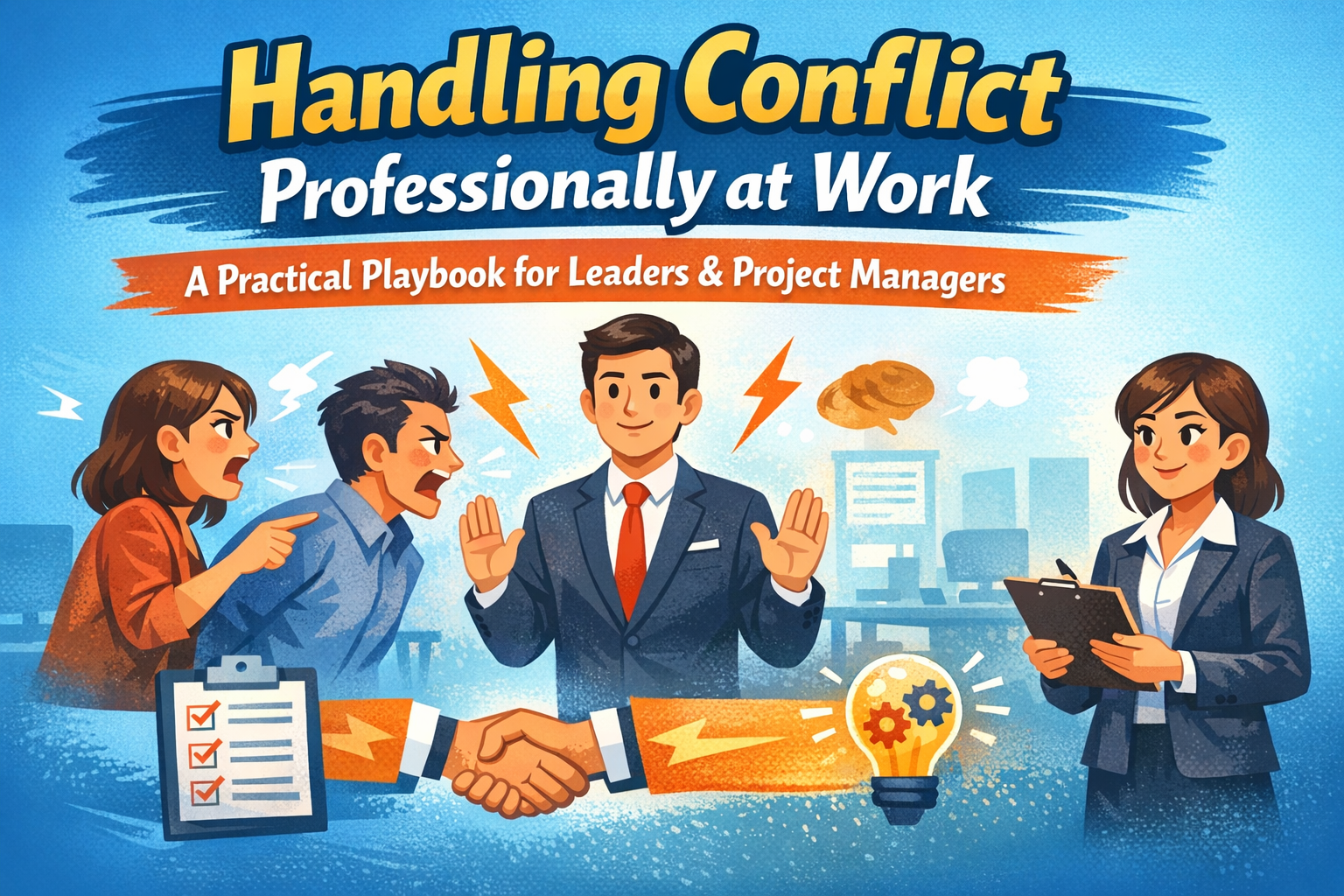
Handling Conflict Professionally at Work: A Practical Playbook for Leaders & Project Managers
Conflict is not a breakdown—it’s a signal. It shows that people care about outcomes, priorities, and quality. The differentiator isn’t whether conflict exists; it’s how effectively you manage it.
Handled poorly, conflict drains productivity and erodes trust.
Handled well, it strengthens alignment, sharpens decisions, and builds high-performing teams.
Let’s break this into a practical, execution-ready framework you can apply immediately.
What Professional Conflict Handling Really Means
Professional conflict management is not about avoiding tension—it’s about channeling it productively.
Core Principles:
- Separate people from the problem
- Focus on facts, not assumptions
- Create a fair and structured discussion
- De-escalate emotions without dismissing concerns
- Maintain accountability while protecting relationships
Bottom line: It’s not about being “nice.” It’s about being effective.
Why Workplace Conflicts Escalate
Most conflicts are not personality-driven—they’re system-driven.
Common Root Causes:
- Misaligned goals
- Unclear roles and ownership
- Resource constraints
- Communication gaps
- Competing incentives
- Unresolved past issues
Leadership insight: Identify the root driver early to reduce escalation quickly.
The 3 Types of Conflict (And How to Handle Them)
1. Task Conflict
Disagreements on priorities or execution.
Healthy when structured properly.
2. Process Conflict
Confusion around roles, timelines, or workflows.
Requires clarity and system fixes.
3. Relationship Conflict
Personal friction or trust issues.
High risk—needs careful, neutral handling.
Key takeaway: Not all conflicts should be managed the same way.
The “Pause – Clarify – Solve” Framework
A simple yet powerful model to handle conflict in real time:
1. Pause (De-escalate)
- “Let’s pause and align on the issue.”
- “I want to ensure we’re solving the right problem.”
Objective: Reduce emotional intensity.
Clarify (Define the Problem)
Ask:
- What outcome are we aiming for?
- What’s the risk or concern?
- What data supports this?
- What’s the impact if we don’t act?
Shift conversation from emotion → facts → impact.
. Solve (Drive Resolution)
- Agree on a decision or decision owner
- Define next steps and accountability
- Align on success criteria
Conflict is resolved only when there’s a clear path forward.
A Simple Script for Difficult Conversations
Use this structure to keep conversations professional and solution-focused:
- Observation: “When X happened…”
- Impact: “…it caused Y…”
- Need: “What we need is…”
- Request: “Can we agree to do Z going forward?”
This removes blame and creates clarity.
How to Stay Calm Under Pressure
When emotions rise, your response defines leadership.
Practical Tactics:
- Slow your tone and pace
- Ask questions instead of reacting
- Mirror understanding: “So your concern is…”
- Re-align on shared goals
- Take a short break if needed
The calmest person often becomes the decision anchor.
Managing Conflict Between Team Members
As a leader or project manager:
- Bring both parties together (if appropriate)
- Set ground rules (respect, no interruptions)
- Focus on behavior, not personality
- Convert complaints into actionable requests
- Agree on short-term working agreements
- Follow up consistently
Critical success factor: Follow-through—not just mediation.
Handling Conflict in Remote Teams
Remote environments amplify miscommunication.
Best Practices:
- Shift from chat to voice quickly
- Confirm intent before reacting
- Document decisions clearly
- Address sensitive issues privately
A short call can prevent prolonged friction.
When and How to Escalate
Escalation is not failure—it’s structured governance.
Escalate When:
- Conflict blocks delivery
- Repeated boundary issues occur
- Risks increase significantly
- Decision authority is required
Escalation Framework:
- Summarize the issue concisely
- Present options with impact
- Recommend a solution
- Request a decision timeline
Keep it factual and solution-oriented.
The Most Overlooked Step: Closure
Resolution without closure leads to repeat conflict.
Always Confirm:
- Decision taken
- Responsibilities assigned
- Timeline agreed
- Preventive actions for future
- Relationship reset
Closure builds long-term team resilience.
Final Leadership Principle
Before responding in any conflict, ask:
- Am I trying to win or solve?
- What outcome matters most?
- What does professionalism look like here?
Strong leaders are direct, respectful, and outcome-focused.