

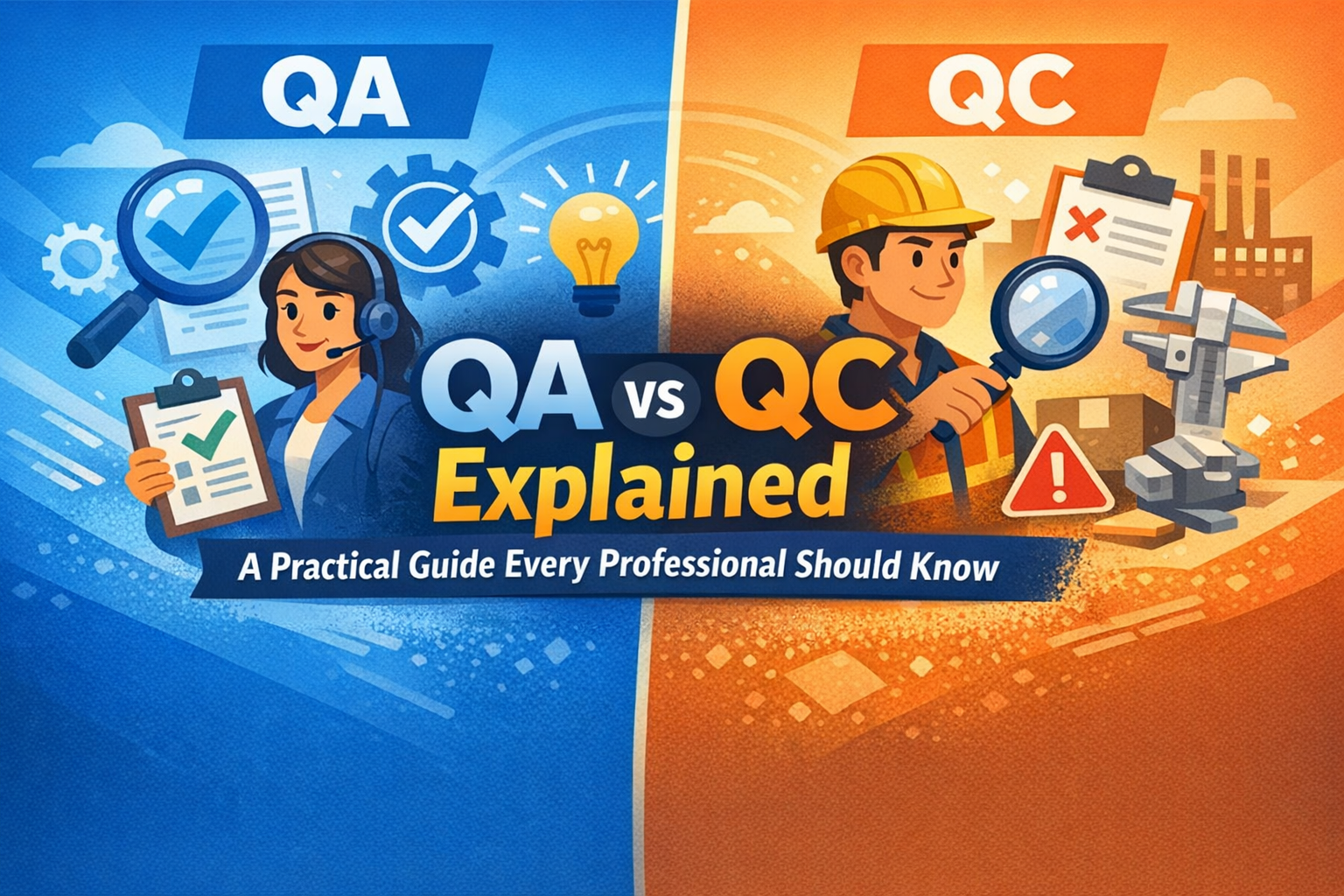
QA vs QC Explained: A Practical Guide Every Professional Should Know
In high-performance organizations, clarity drives consistency. Yet many teams still blur the line between Quality Assurance (QA) and Quality Control (QC)—leading to inefficiencies, rework, and avoidable costs.
If you’re operating in project management, IT, construction, manufacturing, or any delivery-driven function, understanding QA vs QC is not optional—it’s a core capability.
Let’s simplify it in a way that’s actionable and easy to implement.
What Is Quality Assurance (QA)?
Quality Assurance is a process-driven approach focused on preventing defects before they occur.
Instead of asking, “Is the final output correct?”
QA asks, “Are we following the right process to ensure consistent quality?”
Key Insight: Prevention Over Correction
QA is proactive. It embeds quality into workflows before execution begins.
Common QA Activities:
- Designing Standard Operating Procedures (SOPs)
- Defining workflows and governance models
- Training teams on best practices
- Conducting process audits
- Implementing quality frameworks (e.g., ISO standards)
In simple terms: QA builds the system that delivers quality at scale.
What Is Quality Control (QC)?
Quality Control is a result-driven approach focused on identifying defects after execution.
Instead of asking, “Is our process strong?”
QC asks, “Does the final output meet quality standards?”
Key Insight: Detection & Validation
QC is reactive. It ensures deliverables meet expectations before reaching stakeholders.
Common QC Activities:
- Inspecting finished products
- Testing software for defects
- Reviewing deliverables
- Conducting site inspections
- Validating compliance with specifications
In simple terms: QC checks whether the outcome meets the required quality.
QA vs QC: The Core Difference (Simplified)
| Aspect | QA (Quality Assurance) | QC (Quality Control) |
|---|---|---|
| Focus | Process | Product |
| Approach | Proactive | Reactive |
| Goal | Prevent defects | Detect defects |
| Timing | Before & during execution | After execution |
Quick takeaway:
- QA builds quality into the process
- QC verifies quality in the result
Real-World Example (Construction Project)
QA in Action:
- Define construction standards
- Train teams on execution methods
- Use checklists for each phase
- Validate materials before use
QC in Action:
- Inspect completed structures
- Check measurements, strength, alignment
- Identify defects
- Approve or reject work
Both functions are essential—but they operate at different stages.
Why QA Is a Strategic Advantage
Organizations that rely only on QC often fall into a reactive loop:
- Higher rework costs
- Delayed timelines
- Inconsistent quality
- Reduced team efficiency
QA shifts the model from fixing problems → preventing problems.
Outcome: Lower costs, faster delivery, and predictable quality.
Why QC Still Matters
Even with strong QA frameworks:
- Human errors occur
- External variables impact outcomes
- Not all risks can be anticipated
QC acts as a final validation layer, ensuring client-ready deliverables.
QA + QC = High-Performance Delivery System
Top-performing teams don’t choose between QA and QC—they integrate both.
- QA optimizes the process
- QC validates the output
Combined impact:
- Reduced rework
- Improved consistency
- Higher customer satisfaction
- Stronger operational
Common Mistakes to Avoid
- Over-reliance on QC (fixing instead of preventing)
- Treating QA as documentation only
- Skipping inspections to save time
- Lack of standardized processes
- Ignoring continuous improvement
Quality is not a one-time effort—it’s a continuous system.
Final Takeaway
If you remember one principle, make it this:
QA ensures you do things right from the start
QC ensures the final result is right
World-class teams don’t inspect quality into a product—they build it into the process.