
If you’ve been in project management for more than a few months, you’ve probably heard the term “Critical Path Method” (CPM). Maybe it conjured up images of complex diagrams, confusing formulas, and advanced software.
Here’s the truth: CPM is actually one of the most practical tools you can use. It’s not about math—it’s about focus.
When you truly understand CPM, you gain the ability to:
- Predict how long your project will really take
- Identify exactly which tasks can derail your deadline
- Stop wasting energy on tasks that don’t matter
- Make smarter calls when things go wrong
In this guide, I’ll walk you through CPM step by step. No jargon. No unnecessary complexity. Just the practical logic you need to manage real projects—whether you’re in construction, IT, marketing, or operations.
What Is the Critical Path Method?
Let’s start with a simple definition.
The Critical Path Method (CPM) is a scheduling technique that helps you find the longest sequence of dependent tasks in your project.
That sequence is called the critical path.
Why does it matter? Because the critical path determines the shortest possible time your project can be completed. If any task on this path is delayed, your entire project is delayed.
Think of it like a chain. The critical path is the weakest link—except in this case, every link on that path is critical. Break one, and the whole chain falls apart.
In simple terms: The critical path = the chain of tasks that directly controls your project finish date.
Why CPM Matters More Than Most PMs Realize
Here’s something many project managers miss: Not all tasks are created equal.
Some tasks have flexibility. Others have zero room for error. CPM helps you see the difference.
With CPM, you can:
- Identify tasks with zero flexibility (no delay allowed)
- Spot tasks with float (slack time you can use)
- Prioritize your monitoring efforts
- Make smarter trade-off decisions
- Allocate resources where they actually matter
Without CPM thinking, you risk managing noise instead of managing impact. You’re busy, but are you being effective?
Core Concepts of CPM (Simplified)
You only need five concepts to understand CPM:
1. Activities (Tasks)
The individual pieces of work that must be completed. Examples: Design, Procurement, Development, Testing.
2. Dependencies
The logical relationships between tasks. The most common is Finish-to-Start (FS) —Task B cannot start until Task A finishes. You can’t test software before it’s developed.
3. Duration
The estimated time to complete each activity. Example: Design = 5 days, Development = 10 days, Testing = 4 days.
4. Network Diagram
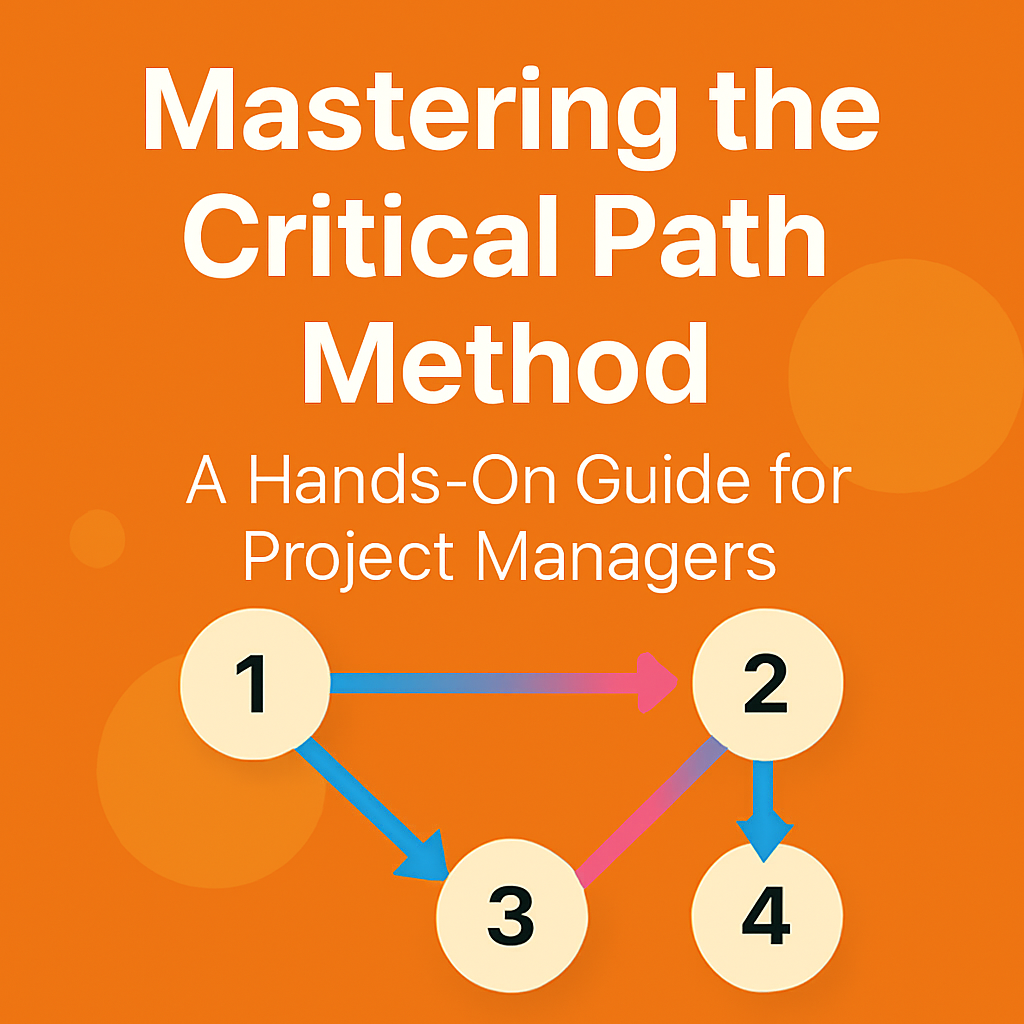
A visual map of tasks and dependencies. Think boxes connected by arrows. Boxes are tasks. Arrows show the flow.
5. Critical Path
The longest path through your network diagram. This determines your minimum project duration.
Step-by-Step: How to Calculate the Critical Path
Let’s walk through a simple example so you can see how this works in practice.
Step 1: List All Activities
| Task | Description | Duration |
| A | Design | 5 days |
| B | Procurement | 4 days |
| C | Development | 10 days |
| D | Testing | 4 days |
| E | Deployment | 2 days |
Step 2: Identify Dependencies
- A must finish before C starts
- B must finish before C starts
- C must finish before D starts
- D must finish before E starts
Step 3: Draw the Network (In Your Mind)
You have two paths running in parallel:
- Path 1: A → C → D → E
- Path 2: B → C → D → E
Step 4: Calculate Path Durations
- Path 1: 5 + 10 + 4 + 2 = 21 days
- Path 2: 4 + 10 + 4 + 2 = 20 days
The longest path is 21 days.
Therefore:
- The critical path = A → C → D → E
- Project duration = 21 days
If Task A is delayed by one day, the whole project is delayed. But if Task B is delayed by a day? The project might still finish on time, because that path is shorter.
What Is Float (Slack)?
Float (or slack) is the amount of time a task can be delayed without affecting the project end date.
In our example:
- Path 2 was one day shorter than the critical path.
- That means Task B has 1 day of float.
Here’s the golden rule:
- Tasks on the critical path have zero float. No wiggle room.
- Tasks off the critical path may have positive float. Some wiggle room.
Understanding float helps you make smart decisions. If someone asks to take longer on a non-critical task, you can check the float and give a confident yes or no.
Forward Pass & Backward Pass (Without the Headache)
In formal CPM, you’ll hear about forward passes and backward passes. Here’s what they actually mean:
- Forward Pass: You move from start to finish, calculating the earliest each task can start and finish.
- Backward Pass: You move from finish to start, calculating the latest each task can start and finish without delaying the project.
The difference between the latest start and earliest start gives you the float.
Good news: Modern project software does these calculations automatically. Your job isn’t to be a calculator—it’s to understand the logic behind the numbers.
Common Mistakes When Using CPM
Even experienced PMs make these errors. Avoid them.
❌ Mistake 1: Ignoring Dependencies
If your dependencies don’t make logical sense, your schedule is fiction. Garbage in, garbage out.
❌ Mistake 2: Focusing Only on the Initial Critical Path
The critical path can change during execution. A delay on a non-critical task might push it onto the critical path. Keep watching.
❌ Mistake 3: Confusing Busy with Critical
A task might look complex and keep your team busy, but if it’s not on the critical path, it’s not controlling your deadline.
❌ Mistake 4: Not Updating the Schedule
CPM only works if you feed it current data. Update progress regularly, or your critical path becomes a historical artifact.
CPM in Real-World Projects
Construction
CPM is the backbone of construction scheduling. If foundation work is delayed, everything else shifts. No exceptions.
IT & Software
Even in Agile, CPM matters for fixed deadlines, regulatory approvals, or infrastructure dependencies. You can be flexible with features, but not with launch dates.
Manufacturing
Production line setup, equipment installation, and quality inspections often follow CPM logic. One delay ripples through the entire process.
How CPM Helps in Decision-Making
When a delay hits, CPM answers the tough questions:
- Will this delay affect the final deadline?
- Should we crash (accelerate) this task?
- Where should we add resources?
- Which activities can tolerate a delay?
This clarity transforms you from reactive firefighter to strategic leader.
Crashing & Fast Tracking
When you need to shorten a project, two techniques help:
Crashing
Adding resources to critical tasks to reduce duration. Example: Hiring extra developers to speed up coding. (Warning: This increases cost.)
Fast Tracking
Performing tasks in parallel that were originally sequential. Example: Starting testing before development finishes. (Warning: This increases risk.)
Both have trade-offs. Use them carefully.
CPM vs. Gantt Chart
People often confuse these two.
- A Gantt chart is a visual timeline. It shows when tasks happen.
- CPM is the logic behind the timeline. It shows why tasks happen in that order.
You can have a Gantt chart without understanding CPM—but then you’re managing visually, not strategically.
Is CPM Still Relevant in Agile?
Yes—especially in hybrid environments.
Even Agile teams face fixed deadlines, regulatory approvals, and infrastructure constraints. Critical path thinking ensures you stay realistic while staying flexible.
You can run sprints and still know which path controls your launch date.
Final Thoughts
The Critical Path Method isn’t about complicated formulas. It’s about clarity.
It teaches you that:
- Not all tasks are equal
- The longest path controls the deadline
- Zero-float tasks demand your attention
- Delays must be evaluated logically
Master CPM, and you move from tracking tasks to controlling timelines. That’s what separates an average project coordinator from a confident project leader.
Internal Linking Strategy
To improve SEO and keep users on your site longer, insert these links naturally within the article:
- Anchor Text: “Gantt chart”
- Link to: yourwebsite.com/gantt-charts-project-management-guide
- Placement: In the CPM vs. Gantt Chart section.
- Anchor Text: “dependencies”
- Link to: yourwebsite.com/task-dependencies-types-guide
- Placement: In the Core Concepts section under Dependencies.
- Anchor Text: “crashing (accelerate)”
- Link to: yourwebsite.com/schedule-compression-techniques
- Placement: In the Crashing & Fast Tracking section.
- Anchor Text: “resource allocation”
- Link to: yourwebsite.com/resource-management-plan-template
- Placement: In the Why CPM Matters section.
Shortened Version (LinkedIn / Medium)
Headline: The Critical Path Method: Stop Managing Noise, Start Managing Impact
If you track every task equally, you’re working hard but not smart. The Critical Path Method (CPM) changes that.
CPM in one sentence:
Find the longest sequence of dependent tasks. That’s your critical path. Delay any task on it, and your whole project is delayed.
Why this matters:
- Tasks on the critical path = zero flexibility. Watch them like a hawk.
- Tasks off the critical path = may have float (slack time). You can relax—a little.
How to find your critical path:
- List all tasks.
- Map dependencies (what must finish before what).
- Calculate duration for each path.
- The longest path = critical path.
Common mistake:
Focusing only on the initial critical path. It can change mid-project. A delay on a non-critical task can push it onto the path.
Bottom line:
CPM isn’t complex math. It’s strategic focus. Master it, and you stop guessing—you start controlling.