

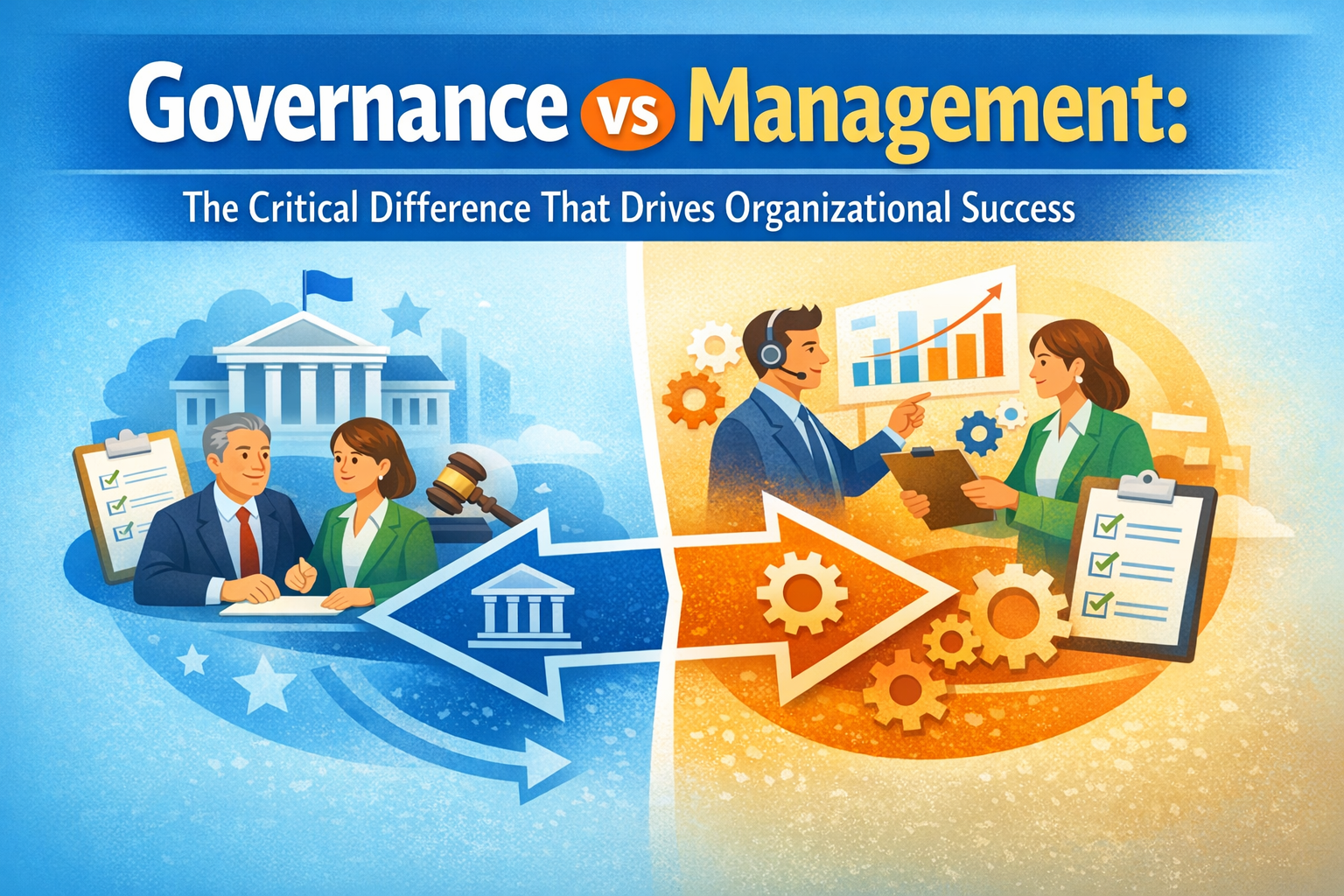
Governance vs Management: The Critical Difference That Drives Organizational Success
In many organizations, governance and management are often treated as interchangeable concepts.
That’s a strategic misstep.
While both functions are essential, they operate at different levels and serve distinct purposes. When organizations fail to differentiate between them, it leads to blurred accountability, slow decision-making, and misaligned execution.
Understanding this distinction isn’t just theory—it’s a business advantage.
What Is Governance?
Governance operates at the strategic level, focusing on direction, oversight, and accountability.
It answers key leadership questions:
- Where is the organization heading?
- Are strategic decisions aligned with long-term goals?
- Are risks being managed responsibly?
Governance is typically handled by boards, executives, or steering committees. Their responsibilities include:
- Defining vision, mission, and strategy
- Establishing policies and governance frameworks
- Ensuring regulatory compliance
- Monitoring performance at a high level
- Holding management accountable
In essence: Governance defines what needs to be achieved and why.
What Is Management?
Management operates at the execution level, translating strategy into action.
It focuses on:
- How objectives will be achieved
- Resource allocation
- Task execution and delivery timelines
Managers and project leaders are responsible for:
- Planning and scheduling
- Team coordination
- Monitoring progress
- Solving operational challenges
- Delivering outcomes
In essence: Management defines how and when things get done.
Governance vs Management: Key Differences
| Aspect | Governance | Management |
|---|---|---|
| Focus | Strategy & oversight | Execution & delivery |
| Level | Leadership / Board level | Operational level |
| Responsibility | Direction & accountability | Implementation & performance |
| Core Question | What & Why | How & When |
Governance ensures you’re doing the right things.
Management ensures you’re doing things right.
Why This Distinction Matters
Organizations that fail to separate governance from management often experience:
- Leadership micromanaging operations
- Lack of clarity in decision-making
- Slow execution cycles
- Weak accountability
On the flip side, organizations that align both effectively benefit from:
- Faster decision-making
- Clear ownership and accountability
- Strong alignment between strategy and execution
- Improved business outcomes
What Happens When One Is Missing?
Without Governance:
- Teams execute efficiently—but without direction
- Strategic misalignment becomes inevitable
Without Management:
- Strong strategies fail due to poor execution
- Plans remain theoretical with no tangible results
Sustainable success requires both working in sync.
Real-World Example: Construction Project
Let’s simplify this with a practical lens:
Governance defines:
- Project objectives
- Budget limits
- Risk thresholds
- Strategic priorities
Management handles:
- Scheduling tasks
- Managing contractors
- Monitoring progress
- Delivering milestones
If governance interferes in daily operations → chaos
If management ignores strategy → failure
Modern Governance: A Shift in Perspective
Today, governance is evolving beyond control mechanisms.
Modern organizations focus on:
- Enabling agility while maintaining oversight
- Balancing innovation with risk management
- Leveraging data-driven decision-making
Governance today is about guidance, not restriction.
The Role of Project Managers
Project managers play a pivotal role at the intersection of governance and management.
They:
- Translate strategy into execution plans
- Align teams with organizational goals
- Communicate progress to leadership
- Manage risks within governance frameworks
A high-performing project manager bridges strategy and execution seamlessly.
Final Takeaway
The distinction is simple—but powerful:
- Governance sets the direction
- Management drives execution
Organizations that master both don’t just operate—they scale, adapt, and lead.
Ask yourself:
Are governance and management clearly defined in your organization—or overlapping?
Because clarity here is not optional—it’s a competitive advantage.